

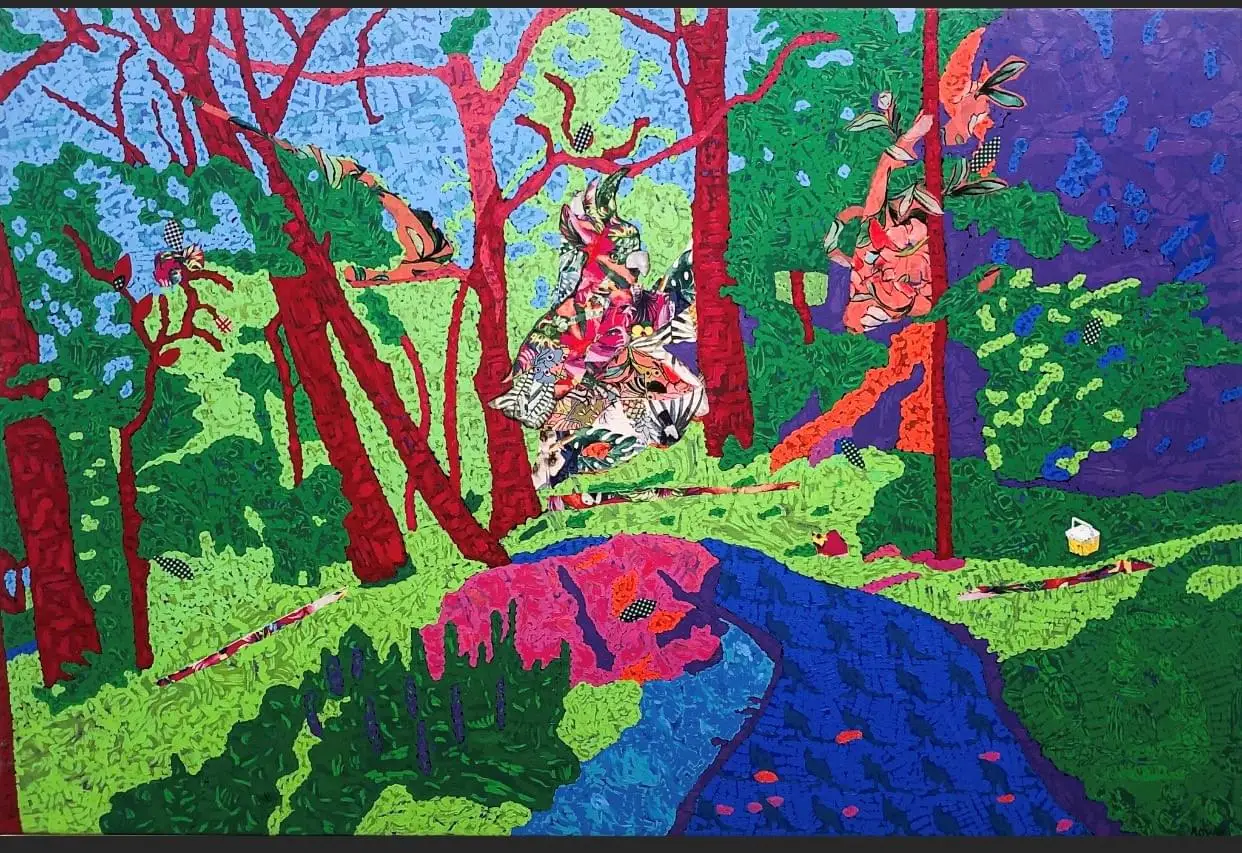
Esky at Hanging Rock (2005-2025 revisited)
$ 6,600.00
Eski originated from the word Eskimo and became Esky, an iconic Australian brand.
My first encounter with Hanging Rock in Victoria was through the 1975 Australian film Picnic at Hanging Rock, directed by Peter Weir and inspired by Joan Lindsay’s 1967 novel. This film profoundly shaped my perception of the landmark during my 2005 visit.
With a sketch pad, I prowled the hidden paths that waded through the reserve. Could I rediscover the location of William Ford’s 1875 painting, At Hanging Rock?
As it was then, it remains the place where nature and human activity blend, where the vitality of trees, wildlife, fauna and flora mingle and connect.
Back in the studio, the plein air experience produced a reconstruction of shapes, and crafted hand-cut stencils (of local flora, fauna, and wildlife) created the underlying textural and rhythmic elements. A dramatic interplay of light and shadow bathed in saturated hues formed the composition and set the mood.
Revisiting this painting twenty years later, 2025 marks a significant turning point.
As we navigate our continuously changing environments, I must ask what memories we hold between the new and the now.
This reflection has ignited a robust dialogue between the past and the present, celebrating a new vital voice, a symbolic voice of nature that urges us not to remain silent when we must speak up.
A reminder that even the smallest of voices can spark a remarkable change in the world.